
Video Chat No Login
Video chat no login is a specific demand: the full face-to-face video experience without any of the identity infrastructure that most platforms treat as a prerequisite. No email to verify. No password to create. No profile picture to upload. No username to choose. On this platform, the camera activates, a stranger from somewhere in the world appears on screen, and the conversation begins — all of it within two seconds of your first click, with nothing collected about you at any stage before, during, or after the call.
What Login Actually Takes from a Video Call
Login is not a neutral step. When a platform requires you to create an account before a video call, it is not simply managing your access — it is collecting an identity, attaching that identity to a database record, and beginning the process of linking your behaviour to a persistent profile. Every call you make, every person you speak to, every topic that keeps you on screen longer becomes a data point in a record that exists independently of your use of the platform.
The no-login model removes every layer of that infrastructure. There is no identity to collect, no record to build, and no profile to accumulate. The call is a call and nothing else. When it ends, neither the content nor the fact of your participation in it exists in any system. The next call begins from an equally clean state. That structural absence of identity architecture is what “no login” means in practice rather than just in the entry experience.
The quality of conversation changes when both parties know this. People who understand that neither party’s calls are logged under an identity that could be retrieved, analysed, or exposed tend to speak differently — with less managed self-presentation and more direct engagement with what is actually being said. The absence of login is not just a convenience. It is a condition that changes what conversations are worth having.
A Bigger Pool From the Login Barrier’s Absence
Every step added to the entry process reduces participation. Login requirements filter out users who value their privacy, users without stable email addresses, users in contexts where creating foreign accounts is complicated, and users who simply do not want to commit to a platform before trying it once. Removing login removes all of those filters simultaneously, which is why the pool here is consistently more diverse than login-required platforms can produce.
The Camera Connects, Nothing Else Does
When you open a call here, the camera connects your face to another person’s screen. That is the only connection the platform facilitates. No identity link. No call history entry. No association between your face and a named account. The visual presence is genuine and live; everything else about you remains completely absent from the platform’s systems from the moment you open the call to the moment you close it.
Every Call Starts Without Context
A login-based platform always knows how many calls you have made, how long they lasted, and whether you come back. That context shapes the product’s behaviour toward you over time — in recommendations, in session defaults, and in the engagement mechanics designed to increase your usage. Here, every session starts from the same blank state. The platform has no accumulated context about you and cannot use it.
Six Features That Work Without Ever Knowing Who You Are
Every capability below operates in full without any identity information from you. None of them are reduced versions of something better available to logged-in users, because logged-in users do not exist on this platform.
Exit and Return Without Re-Authentication
There is no authentication to pass on return visits because there is no account to authenticate against. Every return to the platform is as immediate as the first visit — open the page, press the button, call begins. No session token to renew, no password to remember, no two-factor code to receive. That frictionless re-entry is not a feature of this platform but a natural consequence of having no login infrastructure at all.
Encrypted Stream Without Identity Verification
End-to-end encryption applies to every video call without requiring identity verification as a precondition. Most platforms that offer encrypted calls do so only after verifying who you are — the argument being that encryption requires knowing the keys belong to the right person. This platform encrypts the stream itself without reference to any identity. The call is private because the encryption is architectural, not because the identities of the participants have been verified.
Global Video Pool Across 155 Countries
The full 155-country pool is available from the first call without any geographic feature being gated by registration or payment. No “global matching” upgrade exists because there is no account structure to attach an upgrade to. Whether your first call or your thousandth, you draw from the same global pool under the same terms. The stranger’s face on your screen could come from anywhere in that pool and the draw is genuinely random every time.
All Filters, No Membership Required
Gender preference, language selection, and topic tags are available from the same screen as the start button on every visit. None of them require an account to unlock and none are held back for registered users. They are part of the standard session interface available to every visitor at zero cost and zero friction. Using them creates no preference record in any system — the settings apply to the current session and are discarded when the session closes.
Call History That Genuinely Does Not Exist
Most platforms store call history as part of their standard account experience, sometimes regardless of whether the user has opted in. This platform has no call history because there is no account to attach one to. The calls you have made here exist only in your own memory. No log entry, no duration record, no participant identifier, and no timestamp is associated with your device or your visit in any system we operate. The history is genuinely absent, not just inaccessible.
HD Video, No Account Tier Required
Video quality on login-based platforms is frequently where the free-tier ceiling appears — standard definition for visitors, HD for registered users, 1080p for premium subscribers. This platform has no tier structure because it has no accounts. Every visitor receives the same video quality determined by their connection, not their subscription status. HD from the first call on the first visit, indefinitely, at zero cost.
What No-Login Video Chat Produces That Login-Required Cannot
The four qualities below describe outcomes that are structurally impossible on platforms where video calling requires a login — not because those platforms choose to withhold them, but because the login architecture prevents them.
No Breach Risk from Video Call Records
Every platform that stores video call records under user identities creates a data asset that can be breached. A breach of a video call database exposes not just names and email addresses but a record of who you spoke to, how long you spoke, how often, and by inference what was important to you. No such database exists on this platform. There are no call records to breach because the infrastructure required to create them was never built.
Equal Access for Every Type of User
Login requirements create invisible exclusions that platform designers rarely acknowledge: people without stable email addresses, people in environments where foreign account creation carries risk, people who are privacy-conscious enough that any data collection is a barrier, and people who simply want to try something before committing to it. Removing login removes all of those exclusions and produces a community that is genuinely more diverse than any login-gated alternative.
Conversations Freed from Profile Management
When a video call is attached to a profile, both participants arrive with an awareness of that profile and how the call contributes to it. The call is not just a conversation — it is a data point in the record of who they are on this platform. Without a profile, neither participant is managing anything. The call is just a call, which allows it to be evaluated on its own terms rather than through the lens of what it reveals about or reflects on the person making it.
Privacy That Holds Without Exceptions
Login-based platforms often make privacy promises that have exceptions: calls may be reviewed for safety purposes, metadata may be retained for legal compliance, or call logs may be accessible to account recovery teams. This platform’s privacy is not promise-based — it is structural. There is no mechanism for reviewing a call that was never logged. There is no call metadata to retain because the session architecture does not generate it. The exceptions cannot exist because the data they would apply to was never created.
What No-Login Video Looks Like Across Platform Types
Login requirements, account tiers, and video quality gates are standard across most video chat platforms. This table shows where each type sits and what the no-login model specifically changes across the dimensions users care about most.
| Core Attribute | Video Chat No Login | Classic Platforms | Other Random Sites | Mainstream Social |
|---|---|---|---|---|
| 💳 No-Fee Access | ✔ Always | ✔ Free | ~ Freemium | ✔ Free |
| 🚪 Zero Onboarding | ✔ Instant | ✔ None | ✘ Required | ✘ Required |
| 🔐 Data Security | ✔ Encrypted | ✘ None | ~ Partial | ~ Varies |
| 📜 Ephemeral Sessions | ✔ None | ✘ Stored | ✘ Stored | ✘ Stored |
| 🎛️ Advanced Filtering | ✔ Free | ✘ None | ~ Paid | ✘ None |
| 🧩 Interest-Based Matching | ✔ Free | ~ Limited | ~ Paid | ✘ Manual |
| 🌐 Multi-Device Web | ✔ Full | ~ Patchy | ✔ Yes | ~ App Only |
| 🚀 One-Click Launch | ✔ Browser | ✔ Browser | ✘ App Needed | ✘ App Needed |
| ⚖️ Active Community Moderation | ✔ 24/7 | ✘ Minimal | ~ Bots Only | ~ Flags |
| 🕵️ Hidden Identity | ✔ Complete | ~ IP Visible | ~ Partial | ✘ Profile |
Privacy That Video Without Login Actually Requires
Removing login is a privacy decision. Every other privacy decision on this platform was made in the same spirit — minimising what is collected, stored, or knowable about any participant at every stage of every call. These are the specific protections that result.

🔐 What No-Login Video Protects You From
- No email address, phone number, or identity document is ever associated with your video calls on this platform
- No call history is written — the calls you have made exist only in your own memory, not in any database
- Video and audio are encrypted end-to-end before leaving your device; no readable stream exists on our relay
- Your network address is never transmitted to the person on your screen through any platform mechanism
- No cross-session pattern is built from your video usage — each call is treated as independent of every prior one
- Camera access is tab-scoped and automatically revoked when the browser tab closes with no further action required
- No account record exists that could be subpoenaed, breached, or used against your interests in any future scenario
Login Creates a Privacy Liability You Cannot Undo
Once a platform has an account record linking your identity to your call history, that liability exists regardless of what the privacy policy says. The data could be breached in a future security incident, compelled by legal process, or monetised if the platform’s ownership or business model changes. The only effective protection against those outcomes is not creating the record in the first place, which is precisely what the no-login architecture of this platform achieves.
Video Stream Stays Private Without Verification
Some platforms argue that privacy requires identity verification — that you need to know who is on each end of a call to guarantee the encryption is protecting the right person. This platform’s encryption protects the content of the stream rather than the identity of the participants. The video leaving your camera is encrypted before it exits your device. The relay routes it without reading it. The recipient’s browser decrypts it. Identity plays no role in that process.
What “No Call History” Actually Means
On a login-based platform, “no call history” is a setting you can toggle in your account preferences, which reduces what you see in your account view but does not necessarily reduce what the platform retains. Here, no call history means no database table, no logging hook, and no storage layer for session records. The absence is architectural: there is nowhere for a call history to be stored, which is categorically different from a platform that stores it but lets you choose whether to see it.
Safety Without Identity-Based
Human moderation that operates on session-level behaviour rather than account-level identity is both effective and privacy-preserving. A session report triggers a review of what happened in the flagged session. Action is taken based on that review. The person who filed the report is not identified to the moderator. The person being reported is not identified by name. Accountability is enforced at the behaviour level, which is the level that matters for safety, without requiring the identity infrastructure that creates privacy risk.
Why People Specifically Needed No-Login Video
The six accounts below come from people who arrived specifically because a video call without login was what their situation required. Their uses are more varied than the phrase suggests and their accounts describe what the absence of login made possible that login would have prevented.
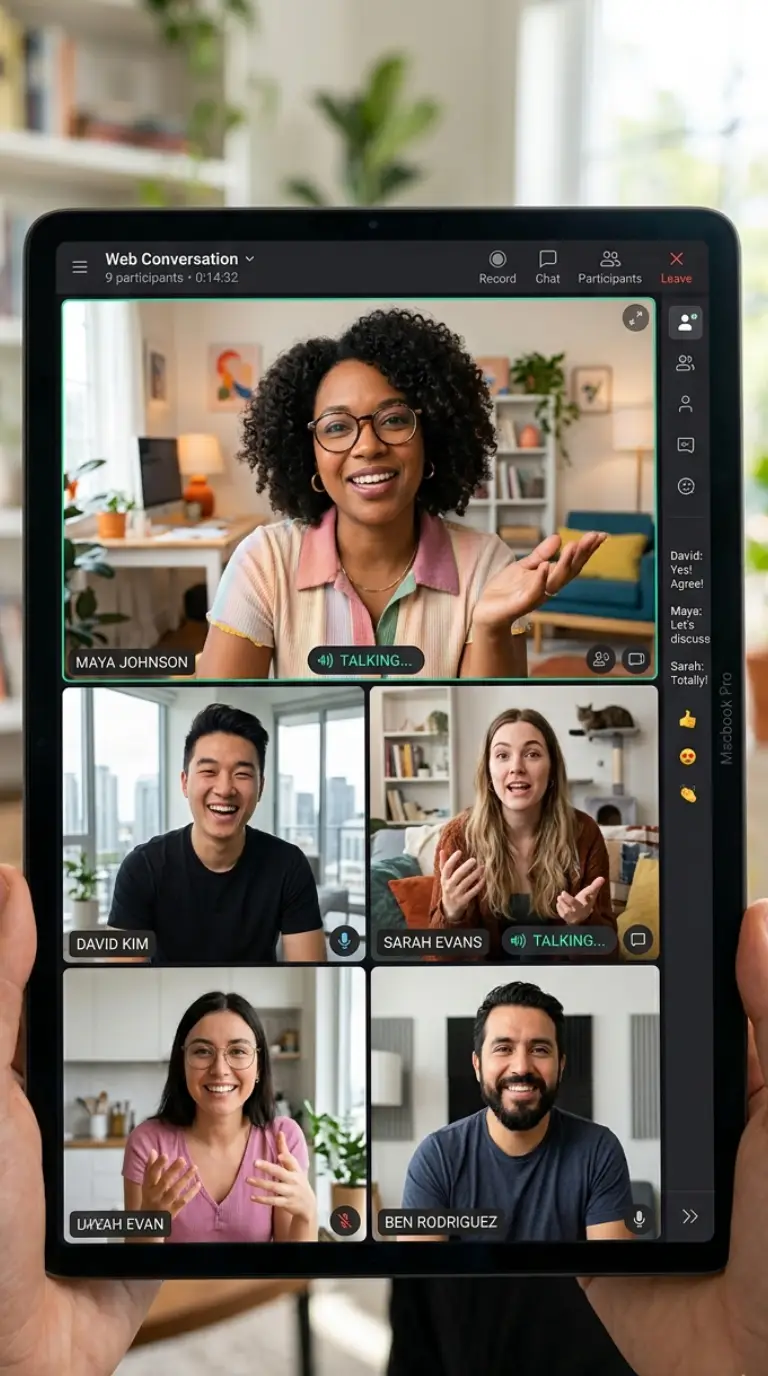
The Camera Is the Entry. Nothing Else Should Be.
Video chat is a remarkably direct form of human connection. Two faces, each responding to the other in real time, with the full non-verbal channel that text communication collapses into absence. The directness of that is the value. Surrounding it with a login form, an email verification step, a password policy, and an account profile adds nothing to the conversation and takes something away from it — the clean entry, the unattached identity, and the condition of mutual privacy that makes people willing to speak honestly on camera to someone they have never met.
This platform removes everything between arrival and conversation. No form to complete. No confirmation email to wait for. No username to invent. No privacy settings to configure on a new account before you trust it enough to turn on your camera. The camera is the entry. The call begins. The conversation is what it is. When it ends, nothing of it persists in any system, and the next call begins from the same clean state.
2.8 million no-login video calls happen here every day. The people making them have chosen face-to-face video without account creation over every login-required alternative available to them. That choice is a statement about what the format delivers when it is not wrapped in the identity infrastructure that most platforms treat as necessary but is not. A video call does not need to know your name. It needs a camera. You have one.
Open the camera. The face is waiting. No login in the way.
Where No-Login Video Makes the Biggest Difference
Removing the login barrier changes who participates in globally meaningful ways. These four regions highlight communities where account creation barriers have historically prevented access to video chat and where the no-login model has produced the most significant growth in participation.
The Fertile Crescent and Levant
Iraq, Syria, Lebanon, and Jordan all have active video chat users for whom the no-login model removes a meaningful barrier. In several of these markets, creating accounts on foreign platforms is legally complicated or socially risky. The absence of any account record eliminates that risk entirely. Arabic is the dominant session language across this cluster, and video session growth from the Levant has been among the fastest of any regional cluster over the past twelve months.
Lusophone Africa
Angola, Mozambique, Cape Verde, Guinea-Bissau, and São Tomé and Príncipe collectively generate active video sessions on the platform. Portuguese is the dominant session language. For users in these markets, the no-login model is particularly significant because it removes the email and phone number verification steps that most login flows require and that a significant proportion of users in lower-infrastructure markets cannot reliably complete.
The Andean Highlands
Bolivia, the Peruvian highlands, and the mountain regions of Ecuador all generate video sessions primarily through mobile browsers. Spanish, Quechua, and Aymara are among the session language preferences from this cluster. No-login video access is particularly valuable in communities where internet access is recent and account management literacy is still developing — the immediate face-to-face connection the platform provides is accessible without the prerequisite digital skills that registration typically requires.
The Malay Archipelago
Malaysia, Brunei, and the outer islands of Indonesia contribute growing video session volumes. Malay, Bahasa Indonesia, and English are represented in session language preferences from this cluster. The no-login model has been a specific driver of adoption on the smaller Indonesian islands, where device OS versions are often too old for current app requirements but browsers remain functional. The platform reaches these users precisely because login and app installation are not part of its access model.
Everything People Ask Before Their First No-Login Video Call
These questions address what is and is not required to make a video call here, how the no-login model interacts with privacy, and what to expect from the call itself.
1. Do I really need nothing to start a video call?
Correct. A browser updated within the last three to four years and an internet connection sufficient to load a webpage are the complete requirements. Your browser will prompt for camera and microphone permission when you start the first video call. That is a standard browser permission request, not a registration step. Once granted, the video connection opens immediately. No form, no email, no username, and no verification of any kind.
2. Will I be prompted to create an account after a certain number of calls?
No. There is no session threshold at which a registration prompt appears. The platform has no mechanism for tracking how many calls any individual has made because no individual tracking exists. Every call is treated as independent of every prior one. You can make calls daily for years without ever encountering a prompt to create an account, because the platform has no account system to prompt you toward.
3. Is the video quality affected by not having an account?
No. Video quality is determined by your camera hardware and connection speed, both of which are independent of account status. The platform does not apply a quality ceiling for visitors who have not registered, because there is nothing to register for. Every visitor receives the same video quality — up to 1080p on qualifying connections — under identical conditions from the first call to the thousandth.
4. Can the person I call identify me from the call?
Only from what appears in your camera and what you choose to say. Your network address is shielded by the relay infrastructure and is not visible to them through the connection. No username, profile, or platform-provided information accompanies your video feed. What they see is your face and your background. What they know about you is what you tell them during the call. The platform contributes no identifying information alongside the video.
5. Is there a record of the call kept anywhere after it ends?
No. The call session produces no record in any database on our systems. No call log entry, no duration timestamp, no participant identifier, and no content fragment is retained after the session closes. The encryption means no readable content ever existed on our relay to retain in the first place. There is nothing to delete, nothing to request under a data access right, and nothing to expose in a breach because the data was never generated.
6. What permissions does the browser request and when?
Camera and microphone permissions are requested by the browser when you start a video session. This is a one-time prompt per browser per site. The permission is active while the tab is open and automatically inactive when it closes. You can revoke it at any time through your browser’s site settings without affecting your ability to use the platform’s text features. No location, notification, or persistent background access is requested at any point.
7. How does the platform handle safety without account-level moderation?
Moderation operates at the session level. The in-session report button routes directly to a human moderator who reviews the flagged session within minutes. The reported participant is suspended from new calls immediately on submission. Action is taken based on session behaviour rather than account identity. That approach is both effective and privacy-preserving: safety is maintained without requiring identity-based accountability, which is what allows the no-login model to coexist with a functional moderation system.
8. Can I use gender or language filters without logging in?
Yes. All filters — gender preference, language selection, and topic tags — are available from the main interface without any account. They are applied to the current session and are not stored for future sessions. Using them creates no preference record. Each time you use the platform, you start from the same blank state regardless of what filters you set in previous sessions. That blank-state design is the same mechanism that makes privacy in this context genuine rather than optional.
9. Is this suitable for sensitive or professional use cases?
Many users employ the platform for sensitive conversations precisely because the no-login architecture removes the account record that would otherwise create a liability. Journalists, researchers, legal professionals, and support workers all use it for cases where the absence of a call log is a material requirement rather than a preference. The end-to-end encryption and zero-retention architecture provide a privacy baseline appropriate for those contexts, though for legally privileged communications, users should consider their specific jurisdiction’s requirements independently.
10. Will the no-login access policy change in future?
The no-login design is architectural rather than policy-based. Introducing login would require building an account infrastructure, a credential management system, and a user database — none of which exists on this platform. Reversing the design is not a policy change that could happen without a complete rebuild of the platform’s core systems. The no-login access is not a commitment we make and could walk back — it is a structural property of the product that cannot be quietly removed.