
Anonymous Chat
Anonymous chat gives you something most digital spaces have quietly eliminated: the ability to speak without a record attached to your words. No username tied to your history, no profile picture signalling your identity, and no conversation log that outlives the session — just two people talking, and nothing left behind when it ends. That is the entire premise, and it is preserved in everything we build.
Why Anonymity Changes What Gets Said
Every platform with persistent accounts creates a subtle but powerful form of self-censorship. People moderate their words based on who might read them later, how a position might look in context, or what a particular opinion could cost them professionally or socially. Anonymous chat removes that filter entirely by making permanence structurally impossible.
On this platform, nothing you say is linked to a name, a location, a history, or a future. The session exists in the present tense only. When it closes, neither the content nor the connection survives on any server. That is not a setting you enable — it is how the system was built, from the networking layer upward.
The result is a different quality of conversation. People ask questions they would never post publicly. They share perspectives they would soften in a professional context. They admit uncertainty without worrying about how it reflects on them. The platform creates the conditions for that kind of exchange simply by refusing to create a record of it.
No Identity, No Performance
When there is no profile to curate and no audience to manage, conversations stop being performances and start being exchanges. The absence of an identity is not a limitation of the format — for many people, it is the only condition under which they are willing to say what they actually think.
Honesty Without Consequence
Permanent platforms punish honesty by attaching it to a person indefinitely. Here, opinions belong to a moment rather than a record. That shift changes the dynamic of the exchange in ways that users consistently describe as qualitatively different from anything they experience on conventional social platforms.
Connection Without Obligation
Speaking with someone anonymously does not create a relationship that needs to be maintained, a contact that expects follow-up, or a social debt of any kind. Each conversation is complete in itself, which lowers the threshold for starting one and removes the friction of ending it when the time comes.
Built to Protect Your Privacy at Every Step
The features below are not a privacy checklist added after the fact. They reflect decisions made at the architecture level, before a single line of user-facing code was written, about what kind of platform this was going to be.
No Identity Required, Ever
There is no registration flow because there is no registration mechanism. The platform does not collect a name, an email address, a phone number, or any other identifier at any point in the session lifecycle. You arrive as nobody in particular and leave the same way. That structural anonymity holds regardless of how long you use the platform or how many sessions you start.
Session Content Deleted on Close
Messages, voice data, and video frames are not written to persistent storage during a session. When the connection closes, the content is gone entirely. There is no archive to request, no export function to disable, and no retention period at the end of which data is finally removed — because the data was never retained in the first place.
IP Address Shielded from Other Users
Your network address is never transmitted to, visible by, or inferable by the person you are speaking with. Our relay infrastructure sits between both endpoints and handles routing without exposing either side to the other. The person on screen knows only what you choose to tell them — nothing that arrives with the connection itself.
No Behavioural Profiling
Some platforms that claim anonymity still build behavioural profiles from session patterns, timestamps, and interaction data. We do not. There is no analytics layer tracking how long you stay, what you skip, or when you return. Each session is treated as the first and only session from a system that has no memory of the previous one.
Speak Under Any Name or None
If you want to use a nickname within a session, you can. If you prefer to say nothing identifying at all, the platform functions identically. There is no display name field that must be populated before a session starts, no avatar upload prompt, and no profile completion percentage nudging you to add more about yourself.
What We Do and Do Not Collect
We do not obscure our data practices behind a dense privacy policy written to protect the platform rather than the user. The short version is accurate: we collect nothing that identifies you, we store nothing that persists beyond your session, and we share nothing with anyone under any circumstances. The longer policy says the same thing in more detail.
What Makes This the Right Choice for Anonymous Conversation
There are other platforms that offer some form of anonymous interaction. The four qualities below explain why the experience here is substantively different from most of them and why that difference shows up in how conversations actually feel.
Anonymity Enforced by Architecture
Most platforms rely on policy to protect user identity. Policy can be changed, ignored, or overridden by legal pressure. Architectural anonymity cannot be reversed without rebuilding the system. We chose the latter because a privacy promise that can be broken by a board decision is not a privacy promise worth making.
A Diverse Matching Pool That Stays Private
The people you meet here span over 130 countries and dozens of languages. Reaching that breadth of human diversity without attaching your identity to the process is something no conventional social platform can offer. The scale of the pool and the depth of the anonymity reinforce each other rather than being in tension.
No Dark Patterns Eroding Privacy
Some platforms call themselves anonymous while nudging users toward signing up for a better experience, linking an account to save preferences, or verifying identity for trust purposes. None of those prompts exist here. There is nothing to sign up for, no preferences to save, and no trust score that depends on revealing who you are.
Always Available, Always the Same
The anonymous experience does not degrade at peak hours, limit itself to certain times of day, or change based on how recently you used the platform. Four million daily sessions mean the matching pool is full around the clock. The privacy protections apply equally to a session at noon and one at three in the morning.
Comparing Levels of Anonymity Across Different Platforms
Not all platforms use the word “anonymous” to mean the same thing. This table shows what is actually protected on each type of service and where the gaps in that protection tend to appear.
| Feature | Anonymous Chat | Omegle-style | Chatroulette | Social Media |
|---|---|---|---|---|
| 💰 100% Free Forever | ✔ Always | ✔ Free | ~ Freemium | ✔ Free |
| 🚫 No Registration | ✔ Zero | ✔ None | ✘ Required | ✘ Required |
| 🔐 End-to-End Encryption | ✔ All Sessions | ✘ None | ~ Partial | ~ Varies |
| 🗑️ Zero Chat Logs | ✔ Always | ✘ Stored | ✘ Stored | ✘ Stored |
| 🎭 Full Anonymity | ✔ Complete | ~ IP Visible | ~ Partial | ✘ Profile |
| 🎛️ Gender Filter | ✔ Free | ✘ None | ~ Paid | ✘ None |
| 💡 Interest Matching | ✔ Free | ~ Limited | ~ Paid | ✘ Manual |
| 📱 Mobile Browser | ✔ Full | ~ Patchy | ✔ Yes | ~ App Only |
| ⬇️ No App Download | ✔ Browser | ✔ Browser | ✘ App Needed | ✘ App Needed |
| 🛡️ Active Moderation | ✔ 24/7 | ✘ Minimal | ~ Bots Only | ~ Flags |
Legend: ✔ = Yes / Fully supported | ✘ = No / Not supported | ~ = Partial / Limited
Anonymity and Safety Working Together
A common concern about anonymous environments is that the absence of accountability enables harmful behaviour. We address this not by weakening anonymity but by building robust safety tools that do not require knowing who someone is in order to act on a report about what they did.

🔏 The Anonymity Protections in Place
- No real name, phone number, email address, or government ID is collected at any point during sign-up or use
- Session content is never written to a database and cannot be retrieved after the conversation closes
- Your IP address is routed through our relay infrastructure and is never exposed to the other participant
- No cross-session tracking is performed — each visit is treated as entirely new by every layer of the system
- Third-party analytics scripts, social pixels, and advertising SDKs are absent from every page of the platform
- Audio and video are encrypted in transit from the moment the session begins to the moment it ends
- You can exit any session without trace — no exit data, no last-seen timestamp, and no read receipt is generated
Why Safety Does Not Require Identification
Effective moderation does not need to know who someone is — it needs to know what they did during a session. Our system captures behavioural flags and report submissions without attaching them to an identity. When a report is filed, the session context is reviewed by a human moderator and acted on regardless of whether the reported user’s real identity is known, because it never is.
How We Prevent Abuse Anonymity
Session-level behavioural signals — patterns of rapid reporting, unusually short sessions followed by reports, and content-type flags — allow our moderation system to identify problematic usage without profiling individuals across sessions. Accounts do not exist here, but patterns still emerge and are still acted upon in ways that protect the community.
What Happens After a Report Is Filed
Reports submitted during an active session are reviewed by a human team member rather than processed solely by an algorithm. The reviewing moderator sees the flagged context, assesses it against our community standards, and takes action within minutes. The reported user is removed from the matching pool during review and cannot be matched again until the review concludes.
The Limits of What We Know About You
We know only that a session occurred, approximately when, and through which type of device (mobile browser or desktop). We do not know your name, your location beyond rough regional timezone inference from connection timing, the content of what you said, or whether the same person has visited before. Those limits are intentional and permanent.
Why People Specifically Chose an Anonymous Platform
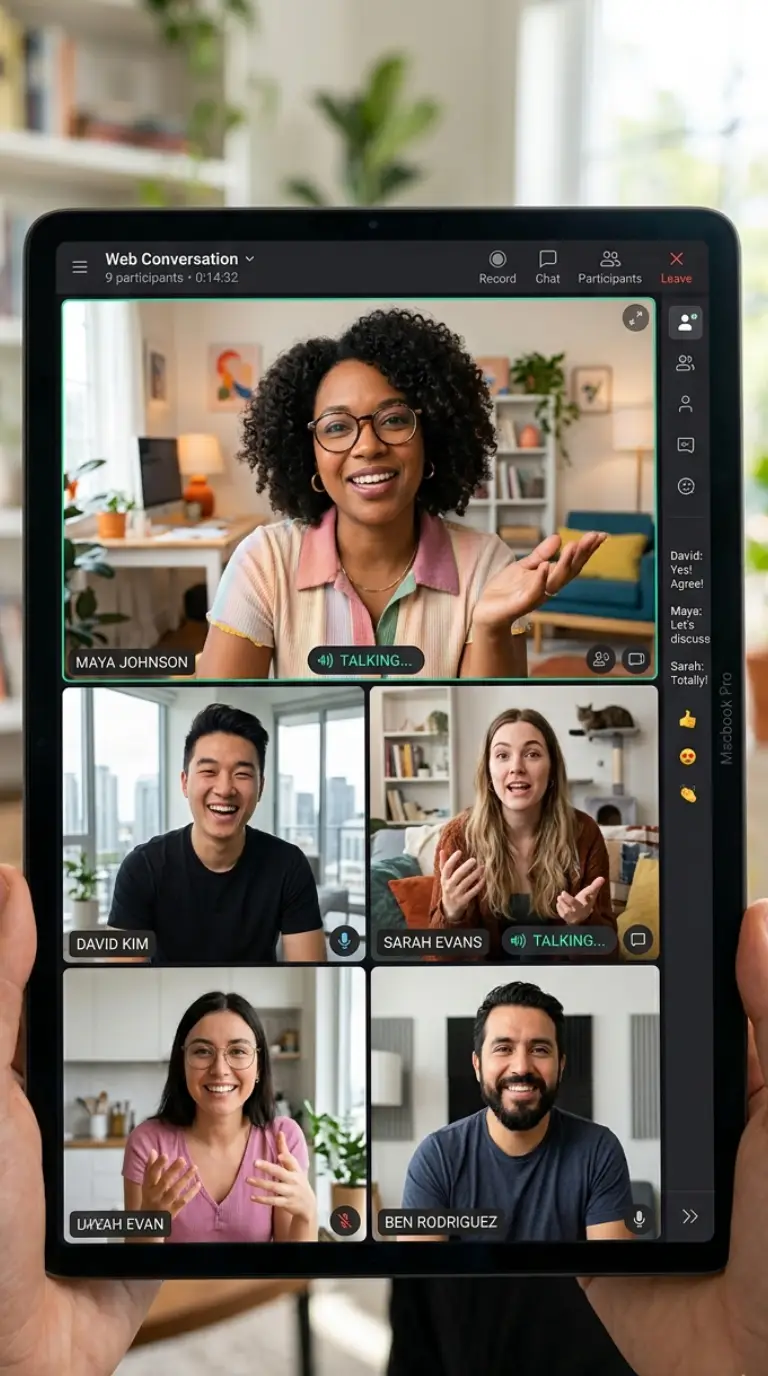
The six people below chose this platform specifically because anonymity mattered to them. Their reasons varied. What they share is that the experience matched the promise.
The Case for Keeping Some Conversations Off the Record
The permanent record is one of the defining features of the modern internet, and it shapes human behaviour in ways that have become so normalised people barely notice them. Self-censorship, impression management, and the careful calibration of public opinion have become reflexive. Most people do not even register doing it anymore. An environment where words are not permanent does not just remove a technical constraint — it removes a psychological one.
Anonymity is not the same as irresponsibility. The assumption that removing identity from a conversation removes accountability is not supported by how people actually behave here. The majority of sessions are civil, curious, and genuinely engaged. People who behave badly in anonymous environments tend to behave badly in non-anonymous ones too — identity does not produce good behaviour, it just shifts where it surfaces.
Some conversations are only possible without a record. The person processing a decision they are not ready to discuss with their network. The student whose developing views do not yet match their community. The professional whose honest opinions would be professionally costly. For all of these people, and many others, the value of this platform is not the randomness or the technology — it is the fact that nothing they say here follows them when they leave.
Four million people use this platform daily. Not one of them created a profile to do it. That is what genuine anonymity looks like at scale, and it is what we are committed to maintaining regardless of what direction the wider internet moves in.
Where People Value Anonymous Conversation Most
The value of speaking without a name attached to your words is felt differently across different parts of the world. These four regions represent clusters where the demand for genuine anonymity is particularly high and where our user base has grown accordingly.
East and Southeast Europe
Bulgaria, Serbia, Croatia, Slovakia, and Moldova contribute a notably active community of users who cite freedom from social and professional surveillance as their primary reason for choosing an anonymous platform. Sessions from this region are predominantly text-based and tend toward longer durations than the platform average.
West and North Africa
Morocco, Algeria, Tunisia, Libya, and Mauritania are among the fastest-growing markets on the platform. Users from this region frequently cite the importance of speaking without their words being permanently associated with their identity — a concern shaped by both social and legal contexts that make unattributed conversation particularly valuable.
East Africa
Kenya, Ethiopia, Tanzania, Uganda, and Rwanda have all seen sustained growth in active sessions. English and Swahili are the dominant session languages across this cluster, and users here show a high preference for text-only sessions, reflecting both connectivity considerations and a deliberate preference for the additional anonymity that text provides over video.
Mainland Southeast Asia
Myanmar, Cambodia, Laos, Thailand, and Vietnam collectively generate a growing volume of sessions in which users explicitly select no-video mode. The desire to engage in conversation without visual identification is particularly pronounced in this region, and the platform’s architecture supports that preference at the same quality level as any other session type.
Your Anonymity Questions, Answered Directly
The questions below focus specifically on how anonymity works here — what is protected, what is not, and why. If you have a question not covered, use the contact link in the footer.
1. Is my identity truly anonymous or just pseudonymous?
Truly anonymous. Pseudonymity means using a name that is not your real one but is still persistent and traceable over time. Here, no name is associated with your sessions at all — not a real one, not a chosen one, and not a system-generated identifier that links your visits. Each session is technically indistinguishable from any other visitor’s first session.
2. Can the platform identify me if required to by law?
We cannot provide what we do not have. Because no account data, no session content, and no identifying information is retained after a session closes, there is nothing to hand over in response to a legal request. The architecture was deliberately designed to make retention of personally identifiable information impossible, not merely against policy.
3. Does the other person know anything about me when we connect?
Only what you tell them during the conversation. No username, no location indicator, no profile picture, and no background information is shared with your match at the moment of connection. Your IP address is shielded by our relay infrastructure. The other person begins the session with precisely the same knowledge about you that you have about them, which is none at all.
4. Are my conversations stored anywhere, even temporarily?
No. Messages, audio, and video are handled in-transit only. Nothing is written to a database during a session. When the connection closes, the content is gone entirely. There is no temporary buffer that clears after a defined period — the system was built to avoid creating that buffer in the first place. There is no version of the data to request, subpoena, or breach.
5. Which countries can I connect with when I talk to strangers?
No. Each session is treated as independent by every system layer. No cookie links your current visit to a previous one. No fingerprinting logic attempts to re-identify returning users. No analytics platform receives data about your session patterns. The platform has no memory of prior visits because it was not built to accumulate one.
6. How does moderation work if no one has an identity?
Moderation operates on session-level signals and submitted reports rather than user identity. When a report is filed, a human reviewer examines the flagged session context. The reported participant is suspended from matching during review. Action is taken based on what happened during the session, not on who the person is — because that information is not available to us and never has been.
7. Can someone find out who I am from the conversation alone?
Only if you tell them. The platform provides no metadata, no profile link, and no technical mechanism through which one participant could identify the other. If you voluntarily share personal information during a conversation, the other person knows it because you said it — not because the platform provided it. What you share is entirely under your control.
8. Is this safe to use for sensitive personal topics?
The technical protections — no data retention, no identity linking, end-to-end encryption — make it structurally appropriate for sensitive conversations. However, the person on the other side of the conversation is a stranger with no professional obligation and no training. For topics requiring clinical guidance — mental health, medical, legal — a qualified professional remains the appropriate resource.
9. Does anonymity apply to video sessions as well?
The technical anonymity protections apply fully to video sessions. No video content is recorded or stored. Your IP address is shielded. No identity data is linked to your camera feed. The visual anonymity of a video call is, of course, subject to what your camera shows — that part is within your control, not ours. Keeping the camera off is always an option.
10. Will the platform ever require identity verification?
No. Identity verification would require collecting and storing identification data, which is incompatible with the architecture of this platform and contrary to its founding purpose. Introducing verification would not be an update — it would be a different product. That product is not something we are building or plan to build.